Best AI Is Changing Traditional Business Models 2026
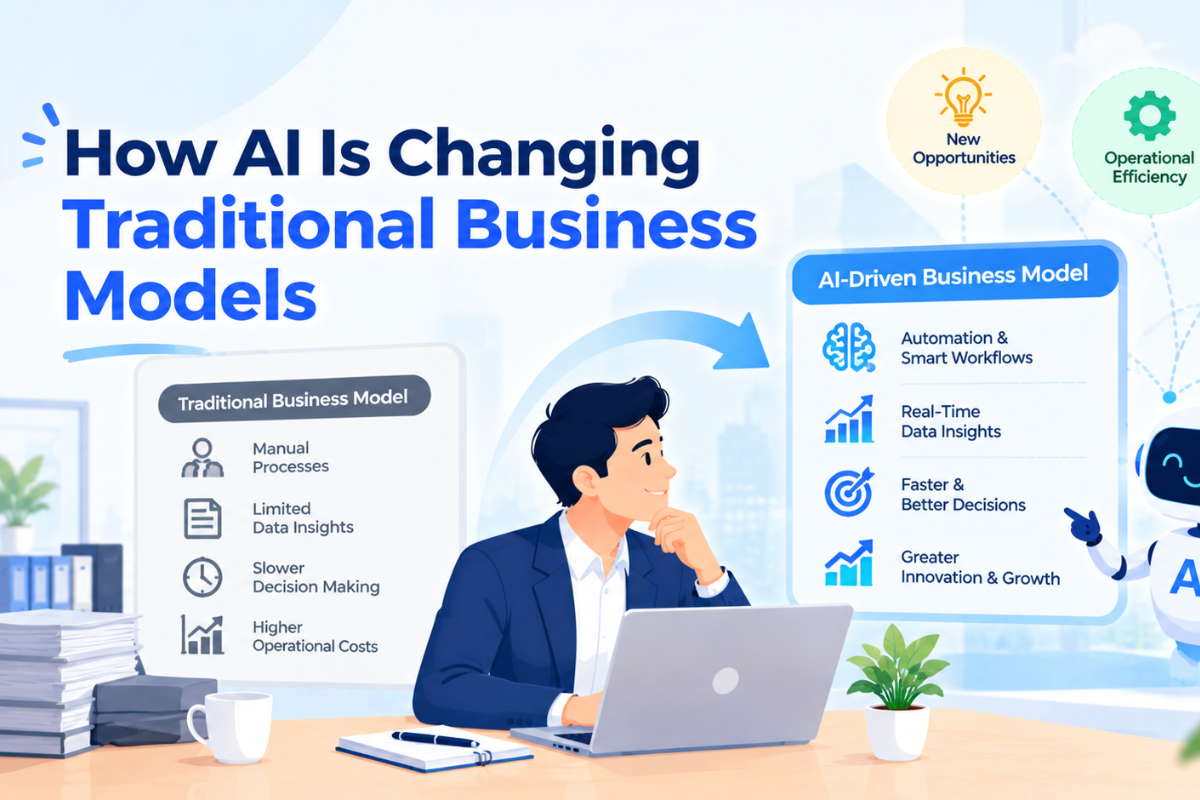
Artificial intelligence is changing more than the tools businesses use. It is reshaping how companies create value, serve customers, manage operations, and compete in their markets. Traditional business models often depend on manual processes, fixed workflows, large teams, and historical data. AI introduces a more adaptive approach where software can analyze information, automate decisions, personalize experiences, and support employees in real time.
This shift does not mean every company needs to replace its existing model with an AI-first strategy. Instead, businesses can identify where intelligent technology can remove friction, create new services, reduce repetitive work, or improve customer outcomes. Organizations that approach AI as a business capability rather than simply a technology upgrade can make more informed decisions about where it fits.
What Does AI Mean for a Traditional Business Model?
A business model explains how a company creates value for customers and generates revenue. AI can influence several parts of that model, including operations, customer relationships, products, pricing, sales, and decision-making.
For example, a traditional retailer may rely on broad customer segments and fixed promotional campaigns. With AI, it can analyze purchasing behavior and customer interactions to create more personalized recommendations. A manufacturer that previously depended heavily on scheduled maintenance can use predictive systems to identify unusual equipment patterns and investigate potential failures earlier.
The important change is not simply automation. AI allows businesses to make their processes more data-driven, responsive, and personalized.
How AI Is Reshaping Traditional Business Operations
One of the most visible changes is happening inside everyday operations. Businesses across industries have repetitive tasks that consume employee time without directly creating significant customer value.
AI can support activities such as:
- Processing and classifying large volumes of documents
- Summarizing reports and business information
- Forecasting demand and inventory requirements
- Automating customer support interactions
- Identifying unusual transactions or operational patterns
- Supporting employees with internal knowledge systems
- Assisting with software development and testing
Consider an insurance company that receives thousands of claims. Instead of asking employees to manually review every document from the beginning, AI can help extract relevant information, organize cases, and identify claims that require closer human review.
The employee remains part of the process, but the workflow becomes more efficient because people can spend more time on complex decisions.
AI Is Creating More Personalized Customer Experiences
Traditional customer experiences often use broad categories. A company might divide customers by age, location, purchase history, or business size and then offer similar experiences to everyone within a segment.
AI makes personalization much more dynamic.
Recommendation engines can use customer behavior to suggest relevant products. Conversational systems can respond to questions based on context. Marketing teams can analyze customer interactions to understand changing interests and identify opportunities for more relevant communication.
For example, an online learning platform can use AI to understand which subjects a learner struggles with and recommend additional material. A financial service provider can use intelligent systems to organize information and provide customers with more relevant guidance, while keeping appropriate human oversight for sensitive decisions.
This changes the customer relationship from a mostly one-way interaction into a more responsive and continuously informed experience.
AI Is Turning Products Into Intelligent Services
Another major change is the evolution of products themselves.
In traditional models, a company may sell a physical product or software license and provide support around it. AI can add intelligence to that product, allowing it to learn from usage patterns, automate tasks, or provide recommendations.
For instance, industrial equipment can incorporate predictive monitoring. Business software can include automated analysis and recommendations. Customer platforms can use AI to identify sales opportunities or summarize customer conversations.
This creates opportunities for businesses to move from simply selling products toward delivering ongoing, intelligent services.
The value proposition can therefore shift from “What do we sell?” to “What outcome can we continuously help the customer achieve?”
AI Agents Are Changing How Work Gets Done
AI agents represent another important development in business models. Unlike a basic chatbot that primarily responds to questions, an AI agent can be designed to complete multi-step tasks using connected systems and defined business rules.
For example, a sales agent could help qualify incoming leads, gather relevant customer information, update a CRM, and prepare a follow-up task for a sales representative. A support agent could classify a request, retrieve information from approved systems, and route complex cases to the appropriate employee.
Businesses exploring this approach may work with Ai Agent Development Partners to design agent workflows around specific operational requirements.
The key consideration is not simply adding an agent to an existing process. Companies need to determine which tasks are suitable for automation, what permissions the agent should have, when human approval is required, and how actions should be monitored.
Generative AI Is Changing Knowledge-Based Work
Generative AI is also influencing traditional business models by changing how employees create and interact with information.
Teams can use generative systems to assist with drafting, summarization, research, coding, documentation, content creation, and internal knowledge access. The technology can reduce the time required for some knowledge-intensive activities while allowing employees to focus on review, judgment, creativity, and business decisions.
For businesses considering advanced generative AI applications, selecting the best companies for generative ai development should not be based only on technical capabilities. Organizations should also examine areas such as data security, integration experience, model selection, governance, testing, scalability, and the ability to understand the company's actual workflow.
A strong implementation starts with a business problem rather than a desire to use a particular model.
How AI Is Changing Revenue and Pricing Strategies
AI can also influence how businesses generate revenue.
Traditional pricing often relies on historical costs, competitor pricing, customer segments, or periodic adjustments. AI can help companies analyze demand patterns, customer behavior, inventory levels, and other business signals to support more responsive pricing decisions.
Similarly, companies can discover new revenue opportunities by analyzing how customers use their products.
A software provider, for example, may identify that customers consistently use a particular capability to solve a specific business problem. That insight could support the development of a specialized service or premium offering.
AI therefore has the potential to support not only cost reduction but also new products, services, and revenue models.
AI Development Requires a Business-First Approach
Implementing AI successfully is not simply about selecting a model or purchasing a software tool. Businesses need to connect technology decisions with measurable operational or customer objectives.
A practical approach includes:
- Identify the business problem
Start with a specific challenge, such as slow customer support, inaccurate forecasting, manual document processing, or inefficient internal workflows. - Assess the available data
Check whether the organization has reliable, relevant, and properly governed data for the intended use case. - Choose the appropriate AI approach
Depending on the problem, the solution might involve machine learning, generative AI, computer vision, predictive analytics, automation, or an AI agent. - Start with a controlled implementation
A focused pilot can help the organization test usefulness, accuracy, integration requirements, and employee adoption before expanding. - Keep humans involved where necessary
High-impact decisions may require human review, approval, and clear accountability. - Measure business outcomes
Track meaningful indicators such as processing time, error rates, customer satisfaction, conversion rates, operational costs, or employee productivity.
This approach helps prevent businesses from investing in AI simply because the technology is available.
Exploring AI Development Capabilities in India
Businesses researching ai development agencies in india may find providers offering capabilities across generative AI, machine learning, computer vision, automation, conversational systems, and AI agent solutions. When evaluating these agencies, companies should consider technical expertise, project experience, development processes, security practices, communication, and ongoing maintenance.
India has a broad technology services ecosystem, so businesses can compare potential partners based on the specific requirements of their AI initiative rather than choosing solely by company size or service claims.
For example, a business building an intelligent customer support platform may need natural language processing, enterprise system integration, knowledge retrieval, monitoring, and human escalation. A provider's ability to handle these connected requirements can be more relevant than a general claim of AI expertise.
How Businesses Can Evaluate AI Providers in the USA
Businesses exploring top ai development companies in usa should look beyond technical portfolios and consider factors such as industry experience, integration capabilities, data security, scalability, communication, and post-launch support.
The right provider should understand the business problem first and then recommend an appropriate AI approach. A company planning an AI-powered customer service platform, for instance, may need expertise in conversational AI, enterprise integrations, data governance, and monitoring.
Evaluating providers against these practical requirements can make the selection process more relevant than relying on generic service lists. Businesses should also clarify ownership, support expectations, security responsibilities, project milestones, and success metrics before starting development.
What Should Businesses Consider Before Changing Their Model?
AI can create significant opportunities, but it also introduces practical challenges. Organizations need to consider data privacy, cybersecurity, model reliability, integration complexity, regulatory requirements, employee training, and ongoing maintenance.
Businesses should also avoid automating a poorly designed process. If an existing workflow contains unnecessary steps, adding AI may simply make the inefficient process faster without solving the underlying problem.
Governance is equally important. Companies should establish clear rules around data access, human oversight, model evaluation, security, and acceptable use.
When selecting Best AI Development Agencies, businesses should therefore look beyond a portfolio of AI projects. Relevant technical experience, domain understanding, communication, security practices, integration capabilities, and long-term support can all affect the success of an implementation.
The Future of Traditional Business Models
AI is unlikely to affect every industry in exactly the same way. Some companies will use it mainly to automate internal processes. Others will build intelligent products, introduce AI-powered services, or redesign customer experiences.
The broader shift is toward businesses that can use data and software to respond faster to changing customer needs and operational conditions.
Traditional business models will not simply disappear because AI becomes more common. Instead, many will evolve by combining human expertise with intelligent systems. Employees can focus on judgment, relationships, creativity, and strategic decisions while AI handles suitable analytical and repetitive tasks.
The companies that benefit from this shift will need more than advanced technology. They will need clear objectives, reliable data, responsible governance, strong processes, and a willingness to continuously improve how work gets done.
Conclusion
AI is changing traditional business models by connecting intelligent technology with the way companies operate, serve customers, develop products, and create revenue. Its impact goes beyond automation. AI can help businesses become more responsive, personalize experiences, turn products into intelligent services, and support employees with faster access to useful information.
The most practical path is to begin with business needs rather than technology trends. When organizations select appropriate use cases, prepare their data, establish responsible controls, and measure real outcomes, AI becomes a business capability that can evolve alongside the company.
Frequently Asked Questions
How is AI changing traditional business models?
AI is changing business models by automating repetitive work, improving decision support, personalizing customer experiences, enabling intelligent products, and creating new digital services and revenue opportunities.
Can small businesses benefit from AI?
Yes. Small businesses can use AI for customer support, marketing assistance, forecasting, document processing, workflow automation, and other focused tasks without redesigning their entire business model.
Are AI agents different from chatbots?
Yes. A chatbot generally focuses on conversation and responses, while an AI agent can be designed to perform multi-step tasks and interact with business systems under defined permissions and controls.
What is the first step toward adopting AI?
The first step is identifying a specific business problem where AI could create measurable value. Businesses should then evaluate their data, workflow, technical requirements, risks, and expected outcomes before selecting a solution.

About Premium Author
This post has been authored and published by one of our premium contributors, who are experts in their fields. They bring high-quality, well-researched content that adds significant value to our platform.
Popular Categories
Stay Connected
Recent Posts